

Businesses are using web data to inform decisions, gain insight into the competition, track market trends, manage multiple accounts, and reduce repetitive tasks. However, if you make many requests to a website, you may encounter issues such as IP blocking, rate limiting, CAPTCHAs, and limited access.
However, by using proxies, you can achieve this. It is important to choose the right proxy service for your business needs, volume of traffic, security needs, and within your budget.
Whether you are looking for a residential proxy, datacenter proxy, mobile proxy, or private proxy, understanding how each type works can help you make the right investment.
In this guide, we will explain how proxies work, which proxy types are suitable for different business use cases, what to look for in a proxy provider, and how to choose a proxy service that delivers consistent performance.
What Is a Proxy and Why Does Your Business Need One?
Proxy servers allow you to mask your IP address. Messages will appear to be coming not from you or your application but from the Proxy Server. There will be instances where you can find that the data is collected using an IP address that is not yours.
The following are some of the most popular usages of the proxy server in businesses:
Market Research
Competitive Research
SEO Audit/Research
- Campaign Monitoring
- Website performance testing
- Regional content testing
- Managing business automation workflows
- Checking website availability from different locations
For example, an e-commerce business operating in multiple countries may want to compare product prices across regional websites. Using a proxy IP associated with a particular location can help the business see region-specific pricing and product availability.
The right proxy website or service can provide access to different proxy solutions, but selecting a service based on your actual needs is more important than choosing one simply because it offers a large number of IPs.
What Is the Proper Way to Select the Best Proxy That Suits Your Needs?
The selection of the appropriate proxy will be based on your purpose, the number of requests sent, the website/platform you use, and the level of reliability you need.
If you are planning to buy proxy services, you need to take into account the following things:
1. Decide on Your Business Needs
Firstly, identify your major need, as different business procedures require different features from the proxy.
Business Use Case | Recommended Proxy Type |
Competitor price monitoring | Residential or datacenter proxy |
SEO research and SERP monitoring | Residential or datacenter proxy |
Regional website testing | Residential proxy |
High-volume data collection | Datacenter or residential proxy |
Mobile app testing | Mobile proxy |
Ad verification | Residential or mobile proxy |
Long-term account management | Dedicated proxy, testing Datacenter proxy |
For example, in a case where an organization has to monitor prices on hundreds of retail websites, speed, coverage, and IP rotation become important. In another scenario, where an organization wants to test its mobile website on a cellular network, it may prefer mobile proxies.
Important point: Do not select the proxy type before understanding your work process. The proxy that works well for collecting information automatically can fail when you need to manage your account or test locations.
2. Learn about the Various Kinds of Proxies
Every type of proxy has its own advantages, disadvantages, pricing models, and performance capabilities. It is essential to understand these differences before choosing a proxy vendor.
Residential Proxies: IP addresses that are used by residential proxies are those assigned to residential broadband connections. The IP addresses are assigned by ISPs to residential computers and networks.
When websites anticipate traffic from residential IP addresses, residential proxies will do the best job in the following tasks: Geographic Market Research, Regional Website Testing, Retail Price Comparisons, harvesting web data from the public internet, and website localization testing. Residential proxy performance in terms of reliability and access is contingent upon the provider.
3. Datacenter Proxy
A datacenter proxy uses IP addresses hosted in data centers or cloud infrastructure rather than residential internet networks.
Suitable for:
Quick access to information
Collecting public data in large quantities
Website testing
Search Engine Optimization (SEO)
Automation of business operations
Proxies located in data centers are usually inexpensive and faster than residential proxies, thus making them a good choice for organizations that prioritize speed and cost efficiency. However, some websites may identify and restrict datacenter IP ranges more easily.
4.Mobile Proxy
A mobile proxy routes traffic through IP addresses associated with mobile networks, such as 4G or 5G connections.
Best suited for:
- Mobile application testing
- Mobile advertising verification
- Testing for mobile websites
- Experience based on mobility
The use of mobile proxies can be helpful in a situation where a company wants to test its services on cell phone networks. They may be costlier than other proxy servers, so they are best selected when mobile network characteristics are genuinely required.
5. Shared Proxy
A shared proxy is when more than one person is using the same IP at the same time.
Best suite
Budget projects
Browsing and researching
Insignificant testing
Simple processes
While shared proxies might help you cut down on costs, the performance and reputation of your IP will depend on what the other users do.
6. Dedicated Proxy:
A dedicated proxy is designated specifically for one customer for the agreed period of time.
Ideal for:
Predictable business processes
Predictable IP use
Private test environments
Applications that need predictable connectivity
Using dedicated proxies enables better control over IP usage, though their efficiency is determined by both the provider’s network and the quality of the IP address.
Should You Choose Shared or Private Proxies?
Perhaps one of the most common concerns that organizations have about proxies is whether it is enough for them to use shared proxies or not.
The answer lies in the significance that you give to consistency, privacy, and reliability.
When should you use private proxies?
Private proxies are a better choice when your workflow requires a consistent IP, more control over traffic, and fewer interruptions caused by other users’ activities.
For instance, an organization providing website tests regularly to different organizations would opt for dedicated proxies because of the unpredictability that comes with using shared IPs.
Whereas shared proxies can be a good starting point for those on a tight budget, a private proxy might prove helpful where there is constant business.
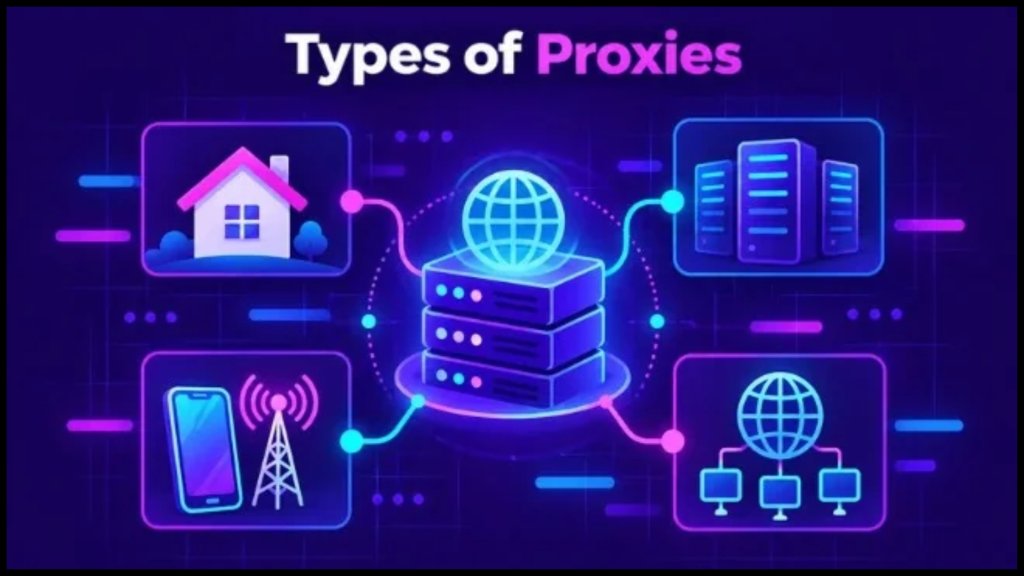
Which Proxy Is Better For Your Business? (Residential Proxy, Datacenter Proxy & Mobile Proxy)
There isn’t a proxy that works perfectly well for everyone. This mainly depends on the type of traffic that your business generates and the destination site or application that you wish to access.
Residential Proxy vs. Datacenter Proxy
Choose residential proxies when location authenticity and residential IP characteristics matter more than raw speed.
Choose datacenter proxies when your primary goals are speed, affordability, and efficient handling of large volumes of requests.
Example: If a store is tracking the public prices of products on regional sites, it can use residential proxies for location-based research and datacenter proxies for sites that support datacenter IPs.
Comparison between Residential Proxies and Mobile Proxies
While residential proxies are often associated with domestic Internet connections, mobile proxies use IPs linked to cellular carrier networks.
For region-specific research and testing related to location, you should go with residential proxies. However, mobile proxies should be preferred for mobile network testing.
Datacenter Proxy vs. Dedicated Proxy
These two terms refer to two different things and should never be confused.
The datacenter proxy refers to the origin of the IP.
The dedicated proxy refers to the way the IP is distributed to customers.
Dedicated proxies can also be datacenter proxies. For instance, an organization can lease a dedicated IP from a data center for its sole use.
What Features Must You Look for in a Proxy Provider?
The selection of a proxy provider is just as significant as choosing a proxy type. There might be millions of IPs offered by a proxy provider.
Before purchasing proxy services, be aware of these requirements.
1. IP Pool Quality & Geographic Locations
A good proxy provider will provide IPs located in locations relevant to your business.
Consider the following:
Cities and Rural Areas, where possible
Types of IP applicable to your process
IP Inventory Update
Sources of IP Information Details
IP Availability in your target areas. If you conduct research across the US, UK, India, Germany, or other markets, confirm that the provider supports the specific locations you need.
2. Speed, Latency and Connectivity
A proxy server that regularly disconnects and has a slow response time may affect efficiency and raise operational costs.
Consider the following performance parameters:
- Latency: How quickly the proxy responds to a request.
- Bandwidth: How much data can be transferred.
- Uptime: How consistently the service remains available.
- Connection stability: Whether connections remain reliable during longer sessions.
For businesses that have operations that run on time, it makes sense to try out a proxy before making any plans.
3. Authentication and Security
In selecting a proxy server for your business, security is the primary consideration.
Check whether the proxy provider supports:
- Username and password authentication
- IP-based authentication
- Secure account management
- Clear privacy and logging policies
- Transparent data handling practices
Do not use proxy providers that give you no information on where their IPs originate and how customer information is being processed.
4. IP Rotation and Session Control
Some business workflows require a different IP for each request, while others need the same IP to remain active for a specific session.
A proxy provider that you can trust should clarify if they have:
IP rotation (automatic)
IP rotation cycle
sticky sessions
control of session length
selection of IPs country-wise
For instance, an IP rotation would suit the research process using public data, while a regional website test would require the same IP for the entire test.
5. Pricing, Scalability, and Customer Support
Look beyond the cheapest proxy plan. Compare pricing based on your expected usage, proxy type, and operational requirements.
A good provider should offer:
- Transparency regarding prices
- Flexibility regarding terms
- Clear limitations of bandwidth/traffic
- Easy upgrades
- Responsive technical support
- Documentation for integration provided
A business that starts with a small project should also be able to expand without rebuilding its entire proxy infrastructure.
How to Buy Proxy Services and Not Waste Your Budget!
Purchasing a proxy without analyzing the needs you have can result in wasted money or an ineffective service.
Steps to take before making a purchase:
Step 1: Define Your Requirements
Write down the things that you would require from your proxy service.
For instance:
Target countries
No. of IPs or Sessions
Monthly traffic
Speed needs
Rotation needs
Type of proxy required
- Budget
- Need speed and affordability? Consider datacenter proxies.
Step 2: Choose the Right Proxy IP Type
Match your requirements with the proxy type instead of buying the most expensive plan.
- Need residential IP characteristics? Consider residential proxies.
- Devices used for cellular network testing.
Use dedicated proxies for consistency in IPS
Step 3: Test Before Scaling
Start with a smaller plan or trial if available. Evaluate connection stability, compatibility, response times, location accuracy, and support quality.
Testing will assist you in determining if the proxy will work with your software without further costs.
Step 4: Review the Provider's Policies
Check acceptable-use policies, IP sourcing practices, privacy terms, refund conditions, and restrictions on traffic or applications.
Proxies need to be used in an ethical and legal manner.
Step 5: Scale Based on Performance
Once you confirm that the proxy meets your requirements, increase usage gradually. Monitor costs, connection failures, response times, and workflow reliability.
What Are the Common Mistakes Businesses Make When Choosing a Proxy?
Selecting a proxy based only on price or advertised IP count can create problems later. Here are some common mistakes businesses should avoid.
Choosing the Cheapest Proxy without Verification
A low-cost proxy might be suitable for basic tasks, but poor uptime, slow connections, or unreliable IPs can create additional costs through wasted time and failed requests.
Always test the proxy before using it in important workflows.
Ignoring IP Type
Not every website treats residential, mobile, and datacenter IPs the same way. Using the wrong IP type may lead to unnecessary restrictions or poor results.
Buying More IPs Than You Need
A large proxy pool is not always necessary. If your workflow requires only a few stable connections, paying for a large pool may be inefficient.
Start with your actual usage and expand only when needed.
Overlooking Customer Support
When proxy connections fail or configuration issues arise, technical support can make a major difference.
Select a vendor that has comprehensive documentation and assistance when you need it, especially if proxies are part of your daily business operations.
Lack of Proxy Compatibility Verification
Some tools require particular authentication methods, IP formats, protocols, or session settings. Confirm that your proxy supports the requirements of your software before purchasing.
How can proxies help different industries?
Proxies are very helpful in many industries where companies need to do genuine online research, testing, or geographic analysis.
E-commerce and Retail
Proxies can help retail businesses with:
Price tracking of products
Promotions comparison across different regions
Product availability analysis
Catalogs analysis of competitors
Experience of shopping in different regions
Digital Marketing and SEO
Marketing agencies can use proxies for:
- Regional search result research
- SERP position monitoring
- Ad verification
- Website testing
- Local SEO research
Data Analytics and Research
Research teams can use proxies to support the collection of publicly accessible information, compare market trends, and test how websites respond from different locations.
Software and Technology Companies
Proxies can be used by developers and quality assurance professionals for the following purposes:
For testing location-based features
To simulate different kinds of network environments
For testing website compatibility
To test API and Application functions
To debug connection issues
It is essential to ensure that proxies are used responsibly, taking into consideration privacy, access restrictions, and platform guidelines.
How Should I Measure a Proxy Before Investing in It?
Do not choose a permanent proxy subscription without an assessment through a straightforward evaluation approach.
Evaluation Criteria Items to Evaluate
IP location: Is the IP located in the desired country/region?
Response time: Are requests responded to quickly?
Reliability: Does the proxy remain connected consistently?
Compatibility: Does it work with your software or browser?
Authentication: Are connection credentials easy to configure?
Help: Is support available for setup and debugging?
Cost: Are costs clear?
Privacy: Are sourcing and data handling policies known?
Conclusion
The choice of the correct proxy service provider will largely depend on balancing all the above factors such as performance, reliability, security, coverage of locations, and price. What suits one company may not necessarily suit another company.
Before purchase, determine your application, analyze different types of residential, data center, mobile, shared, and dedicated proxies, as well as the quality of IP addresses, connection reliability, pricing, and support from the provider.
Choosing the right proxy infrastructure for enterprises using web searches, automation, testing websites, or doing market research could help them make their processes faster.
Proxiesforrent could be a good place to start for businesses looking for a proxy solution. The main thing here is to pick the right proxy solution for you, test it, and only then scale it. Do not choose the most expensive plan or biggest IP pool.
The right proxy isn’t necessarily the one with the most features — it’s the one that helps your business accomplish its goals efficiently, consistently, and responsibly.
You can copy the entire page above directly into your blog editor.
Frequently Asked Questions
1. What is the best proxy for business use?
What works best will depend on what your business needs are. Residential proxies are handy when you need to perform geographical research work. If your main concern is performance, then datacenter proxies are the best choice. Mobile proxies work great for performing tests on mobile networks..
2. Are residential proxies better than datacenter proxies?
However, residential proxies are not necessarily always preferable over datacenter proxies. In some cases, residential IP addresses may be preferred for certain location-specific purposes, while the latter may provide faster connections at reduced prices. It all depends on your specific needs.
3. What is the difference between a shared proxy and a private proxy?
Multiple customers can share the same proxy server, but the private proxy is the one used by only one customer. The shared proxy tends to be cheaper compared to the private proxy.
4. Is a dedicated proxy worth buying?
There are many benefits to having a dedicated proxy server if a stable IP address and guaranteed usage are needed. This would especially come in handy if there were business processes that require a stable IP address.
5. Can I use proxies for SEO and competitor research?
Indeed. Proxies can assist with proper SEO research involving search engine testing, pricing information of competitors, search visibility studies, and geographical testing of websites, among others. Please ensure that you carry out your research in accordance with applicable website policies and laws.
6. How many proxy IPs does my business need?
It all depends on your workflow, level of concurrency, session length, and amount of traffic you have. You might start with just a few IP addresses for smaller projects, while bigger research endeavors might demand more. You can start with a small configuration and then gradually scale up as required.
7. Are private proxies safe to use?
Proxies can offer better control in relation to IP utilization, but not all proxies ensure security and anonymity by default. The safety level depends on the technology used by the provider for proxy hosting and authentication, whether the communication is encrypted, logging rules, etc.
8. What should I check before I buy a proxy?
Before purchase, ensure you look into the proxy type, IP location, speed, uptime, session management, authentication, compatibility, pricing, refund policy, customer service, and IP source. It is always better to test out a smaller plan first.